



Cost plus contract: how it works vs fixed price and T&M
In this article
- How a cost plus contract works
- Cost plus vs fixed price vs time and materials
- When a cost plus contract makes sense
- Clauses every cost plus contract needs
- Allowances: the middle ground on fixed price jobs
- Pricing a fixed price job so the risk is covered
- Switching between contract types
- Running cost plus jobs without drowning in paperwork
- Frequently asked questions
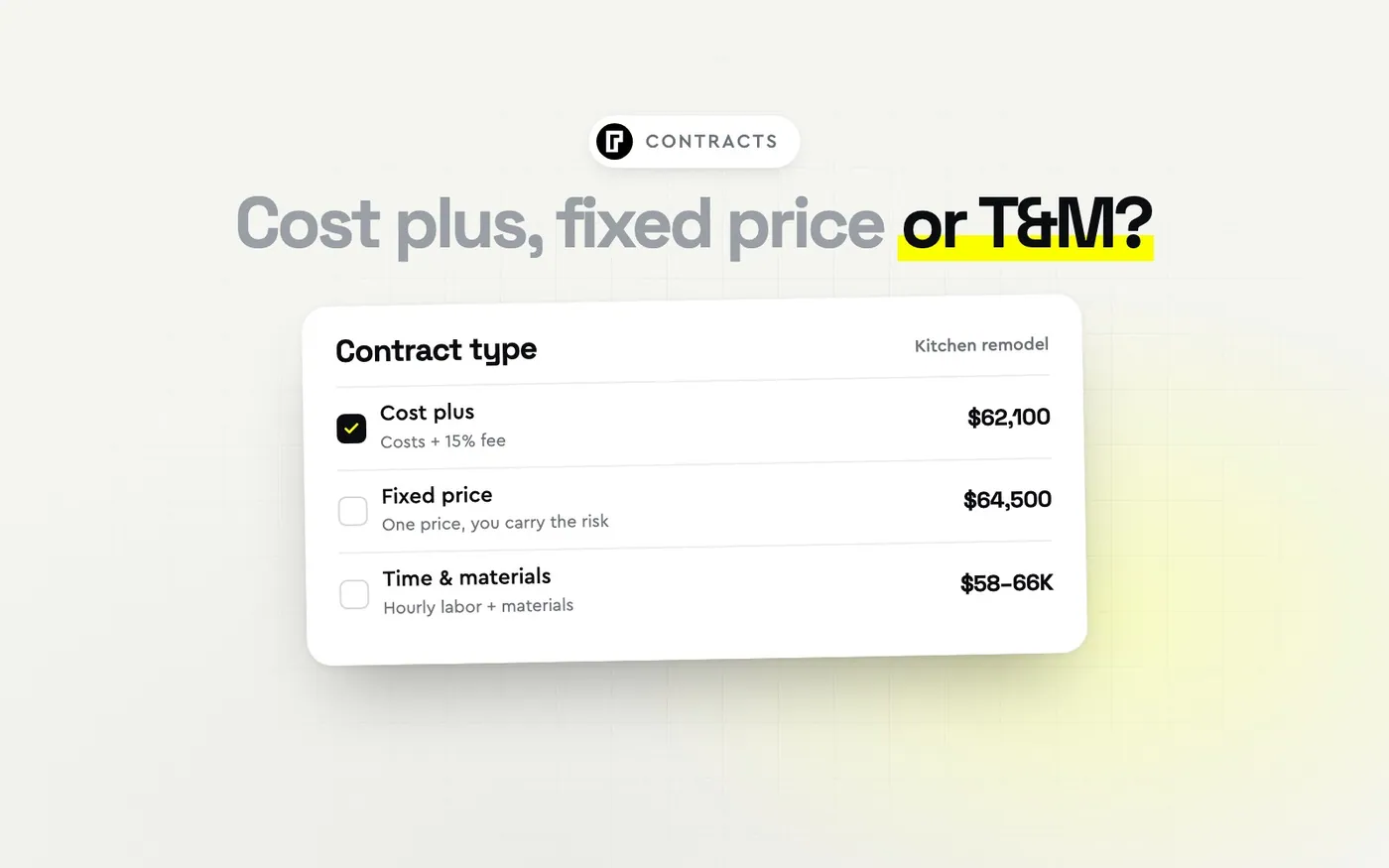
A cost plus contract is a construction agreement where the client pays the actual cost of the work (materials, labor, subcontractors, equipment and permits) plus a fee for the contractor's overhead and profit. The fee is usually a percentage of cost or a fixed amount agreed up front. The client takes on the risk that costs rise; the contractor is paid fairly for whatever the job turns out to need.
It is one of three contract types you will use on residential work. This guide explains how each works, the clauses that matter and how to choose.
How a cost plus contract works
A cost plus contract has two parts:
- Cost of the work. Everything that goes into the job, billed at actual cost with receipts or invoices as backup.
- The plus. Your fee, which covers overhead and profit.
The fee can be set in a few ways:
- Cost plus percentage. The fee is a percentage of total cost, often 10-25% on residential work depending on market and job size. Simple, but the fee grows as costs grow, which some clients dislike.
- Cost plus fixed fee. The fee is a set dollar amount regardless of final cost. Clients like the predictability; you need a well-defined scope so the fee still covers your time if the job grows.
- Cost plus with a guaranteed maximum price (GMP). The client pays cost plus fee up to a ceiling. Costs over the cap come out of your pocket, so you price a contingency into the GMP. Savings under the cap are often shared.
Worked example
A kitchen renovation on cost plus 18%:
| Item | Cost |
|---|---|
| Cabinets and hardware | $22,000 |
| Countertops | $8,500 |
| Electrical and plumbing subs | $9,200 |
| Your labor | $11,000 |
| Permits, disposal, rentals | $1,800 |
| Total cost | $52,500 |
| Fee at 18% | $9,450 |
| Client pays | $61,950 |
If the client upgrades the countertops by $3,000, cost becomes $55,500 and the fee becomes $9,990. On a fixed fee of $9,450 the fee would not move.
Cost plus vs fixed price vs time and materials
Fixed price (lump sum) contracts
You agree one price for a defined scope. If the work costs less than you estimated, you keep the difference; if it costs more, you absorb it. Changes go through a change order.
Best for: well-defined jobs with complete drawings and selections, such as decks, fences, roofs and standard bathroom renovations. Your margin depends entirely on how accurate your estimate is.
Time and materials (T&M) contracts
The client pays an hourly or daily rate for labor plus materials, usually with a markup on materials. There is often a not-to-exceed figure.
Best for: repair work, small jobs, discovery work where you cannot see what is behind the wall, and service calls.
Side by side
| Fixed price | Cost plus | Time and materials | |
|---|---|---|---|
| Who carries cost risk | Contractor | Client | Client |
| Price known at signing | Yes | Estimate only | Rate only |
| Paperwork | Low | High (open books) | Medium (time sheets) |
| Change orders | Formal, priced | Adjust cost, fee may follow | Billed as worked |
| Best fit | Clear scope | Custom homes, big renovations, unknowns | Repairs, service, small jobs |
When a cost plus contract makes sense
- Custom homes and large renovations where selections will be made during the build.
- Old houses where you cannot price what you have not opened up.
- Fast-track jobs that start before drawings are finished.
- Clients who want transparency and are willing to pay for it.
It makes less sense on small, repeatable jobs. The admin of tracking and documenting every cost outweighs the risk you are protecting yourself from.
Clauses every cost plus contract needs
- Definition of cost. List exactly what is reimbursable: labor at what rate, equipment, small tools, insurance, supervision, travel. Ambiguity here causes most disputes.
- The fee and how it is calculated. Percentage or fixed, and whether it applies to change orders.
- Estimate and budget. Even on cost plus, give the client a detailed estimate so they can see where the money goes.
- Guaranteed maximum price, if used, plus how contingency and savings are handled.
- Documentation and audit rights. What backup you provide with each invoice.
- Payment schedule. Usually progress billing every two weeks or monthly against actual costs.
- Change process. How client-driven changes are approved and recorded.
- Lien rights and lien waivers. Contractors and suppliers who are not paid can file a mechanics lien against the property. Spell out how you will provide lien waivers with each payment so the client knows subs and suppliers are paid.
These also belong in fixed price and T&M agreements: scope, exclusions, allowances, payment terms, warranty, dispute resolution and termination.
Allowances: the middle ground on fixed price jobs
Many residential contractors run fixed price contracts with allowances instead of going fully cost plus. An allowance is a dollar amount in the contract for an item the client has not picked yet, such as $4,500 for tile or $2,000 for light fixtures. If the client's choice costs more, the difference comes through as a change; if it costs less, they get a credit.
Allowances keep most of the job fixed while leaving room for selections. They only work if the allowance amounts are realistic. Low allowances make your price look competitive and then produce a string of uncomfortable conversations mid-job. Price allowances from what clients in your market actually choose, and state clearly whether the allowance covers material only or material plus installation.
Offering selections as options inside the proposal, so the client picks and sees the price before signing, removes many allowances altogether.
Pricing a fixed price job so the risk is covered
If you are carrying the cost risk, the estimate has to carry it too:
- Price from a takeoff, not a guess. Measure quantities from plans or the site.
- Use current material and labor costs. A three-month-old price list on lumber or copper is a risk you are choosing to carry.
- Add contingency for what you cannot see. Older homes, additions tied into existing structure and anything behind finished walls.
- List exclusions. Asbestos, rot, permit fees, landscaping repair: whatever is not in the price should be written down.
- Define the change process. Clients accept change orders far more readily when the contract explains how they work before the first one arrives.
Switching between contract types
Some contractors start a job on cost plus for demolition and discovery, then convert to fixed price once the walls are open and the scope is clear. Others run design and preconstruction on a fixed fee before quoting the build. Mixing contract types this way is common on renovations of older houses. Put each phase in writing and make sure the client understands where one ends and the next begins.
Running cost plus jobs without drowning in paperwork
The hard part of cost plus is not the contract. It is tracking every cost against the right job and showing the client clean numbers.
In Bolster the estimate becomes the budget, so actual costs land against the same line items you priced. Purchase orders and vendor bills post to the job, change orders are signed digitally and update the budget, and progress payments go to the client portal for online payment. If you run fixed price work, the same tools show you whether the job is holding its margin while it is still running. See how line item job costing works, or book a demo.
Frequently asked questions
What is a cost plus contract in construction?
A contract where the client pays the actual cost of the work plus a fee for the contractor's overhead and profit, either as a percentage of cost or a fixed amount.
What is a typical cost plus percentage?
On residential work it often falls between 10% and 25%, depending on job size, market and how much overhead the contractor carries.
Is cost plus better than fixed price?
Neither is better in general. Cost plus suits jobs with unknowns or selections still to be made. Fixed price suits clearly defined scopes where you can estimate accurately.
What is a guaranteed maximum price?
A cost plus contract with a ceiling. The client pays actual cost plus fee up to that amount, and the contractor covers anything over it.
What is the difference between cost plus and time and materials?
Both bill actual costs. Time and materials bills labor at an agreed hourly rate and marks up materials, with no separate fee. Cost plus adds a defined fee on top of all costs.
Do I still need change orders on a cost plus job?
Yes. Changes alter the scope, budget and sometimes the fee, so get them approved in writing.