



How to calculate concrete for slabs, footings and posts
In this article
- The concrete volume formula
- How to calculate concrete for a slab
- Footings and walls
- Columns, piers and post holes
- Steps
- How many bags of concrete do I need?
- How much extra concrete to order
- Common concrete estimating mistakes
- Quick reference: common residential pours
- Cement vs concrete
- Ordering ready-mix: what the dispatcher needs
- Estimating the rest of the concrete job
- From cubic yards to a priced estimate
- Frequently asked questions
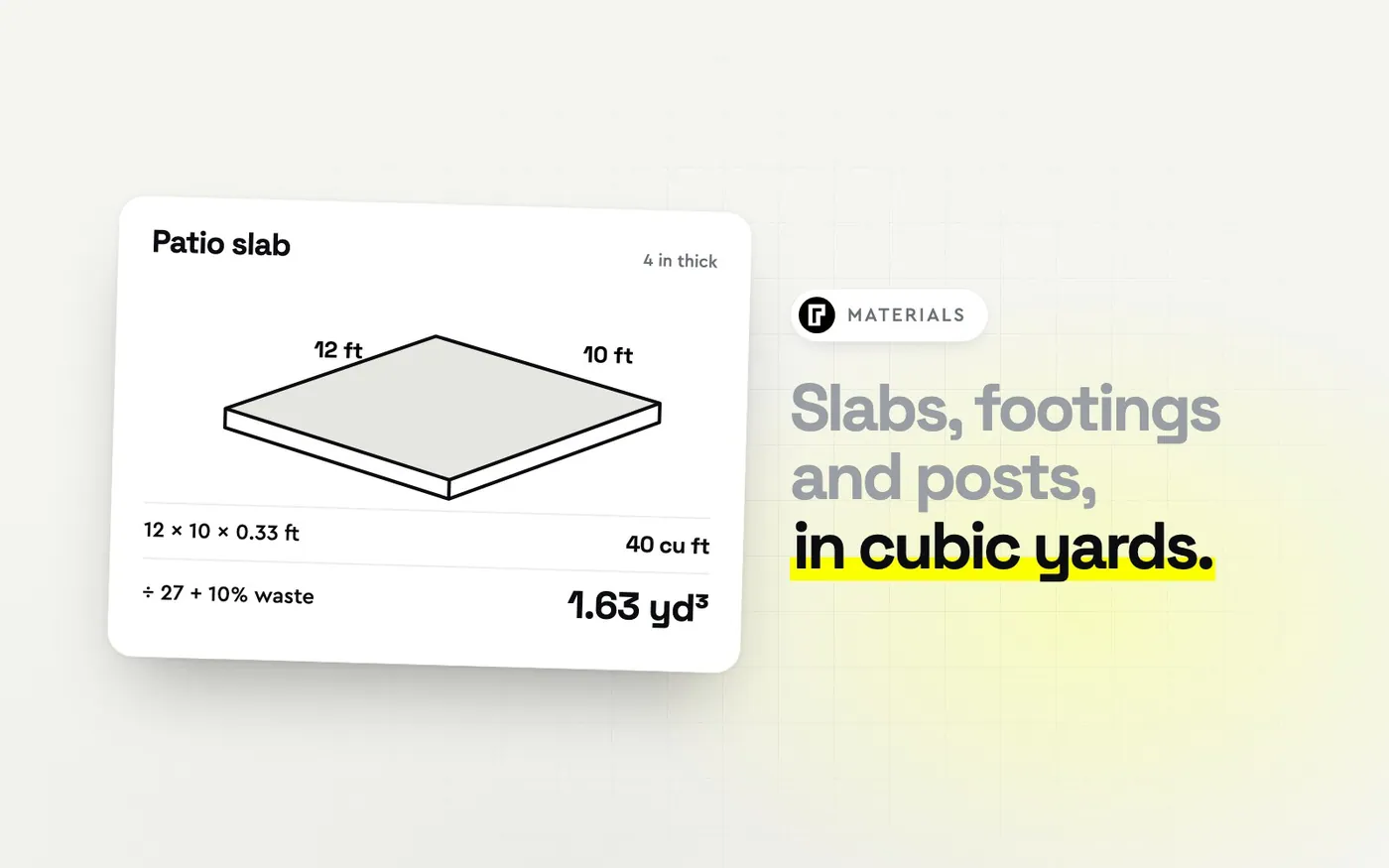
To calculate concrete, multiply length x width x thickness in feet to get cubic feet, then divide by 27 to get cubic yards. A 10 ft x 12 ft slab that is 4 inches thick is 10 x 12 x 0.333 = 40 cubic feet, and 40 / 27 = 1.48 cubic yards. Add 5-10% for waste and order 1.6 yards.
The rest of this guide covers every common pour on a residential job, how to handle inches, how many bags you need for small pours and the mistakes that leave a truck short.
The concrete volume formula
Cubic yards = (length ft x width ft x thickness ft) / 27
There are 27 cubic feet in a cubic yard (3 x 3 x 3). Ready-mix is sold by the cubic yard in the US and by the cubic metre in Canada.
Converting thickness from inches to feet
Divide inches by 12:
| Thickness | Feet |
|---|---|
| 3.5 in | 0.292 |
| 4 in | 0.333 |
| 5 in | 0.417 |
| 6 in | 0.5 |
| 8 in | 0.667 |
| 10 in | 0.833 |
| 12 in | 1.0 |
Metric
Cubic metres = length m x width m x thickness m. 1 cubic yard = 0.765 cubic metres; 1 cubic metre = 1.308 cubic yards.
How to calculate concrete for a slab
Worked example: a 24 x 24 ft garage slab at 5 inches.
- 24 x 24 = 576 sq ft
- 576 x 0.417 = 240 cubic feet
- 240 / 27 = 8.9 cubic yards
- Add 8% for an uneven subgrade: 8.9 x 1.08 = 9.6, so order 9.75 or 10 yards depending on your supplier's increments
Thickened edges add volume. For a 12 in wide x 12 in deep thickened edge around that slab (minus the 5 in already counted): perimeter 96 ft x 1 ft x 0.583 ft = 56 cubic feet, or 2.1 more yards.
Footings and walls
Continuous footing: length x width x depth. 120 linear ft of 20 in x 10 in footing = 120 x 1.667 x 0.833 = 166.7 cubic feet = 6.2 yards.
Foundation wall: length x height x thickness. 120 ft of 8 ft high, 8 in thick wall = 120 x 8 x 0.667 = 640 cubic feet = 23.7 yards. Subtract window and door bucks if they are large.
Columns, piers and post holes
Cylinder volume = 3.1416 x radius² x depth
A 12 in sonotube 4 ft deep: radius 0.5 ft, so 3.1416 x 0.25 x 4 = 3.14 cubic feet. Ten of them = 31.4 cubic feet = 1.16 yards.
Post holes for fences and decks: calculate the hole as a cylinder, then subtract the post. A 10 in hole 3 ft deep holding a 4x4 post (3.5 in square):
- Hole: 3.1416 x 0.417² x 3 = 1.64 cubic feet
- Post: 0.292 x 0.292 x 3 = 0.26 cubic feet
- Concrete: 1.38 cubic feet per hole
Steps
Work out one step as a rectangular block and add them. Three steps 4 ft wide, 11 in deep tread and 7 in rise, stacked: step 1 = 4 x 2.75 x 0.583, step 2 = 4 x 1.833 x 0.583, step 3 = 4 x 0.917 x 0.583. Total about 12.8 cubic feet, or 0.47 yards. Add the landing separately.
How many bags of concrete do I need?
For small pours, premix bags are simpler than a truck. Approximate yields:
| Bag size | Yield |
|---|---|
| 40 lb | 0.30 cubic feet |
| 60 lb | 0.45 cubic feet |
| 80 lb | 0.60 cubic feet |
Bags = cubic feet / yield, rounded up. The ten post holes above (13.8 cubic feet) need 13.8 / 0.6 = 23 bags of 80 lb mix. Above roughly a yard, a ready-mix truck or a short-load supplier is usually cheaper and gives a better pour.
How much extra concrete to order
- 5% on formed work with a flat, compacted base
- 8-10% on slabs over uneven or soft subgrade
- 10%+ on footings dug in rough ground, where trenches end up wider than planned
Running short mid-pour costs far more than a partial yard left over: cold joints, a second delivery charge and crew time waiting. Most suppliers also charge a short-load fee under a minimum volume, so check before you round down.
Common concrete estimating mistakes
- Forgetting to convert inches. 4 inches is 0.333 ft, not 4 ft or 0.4 ft.
- Using nominal form sizes. Measure the inside of the forms.
- Ignoring thickened edges, haunches and grade beams.
- Not checking subgrade depth. A slab poured over a dip is thicker than drawn.
- Leaving out everything else. Rebar or mesh, vapour barrier, gravel base, forming lumber, pump truck, finishing labor and curing all belong on the estimate.
Quick reference: common residential pours
Volumes before waste, at the thickness shown:
| Project | Size | Thickness | Cubic yards |
|---|---|---|---|
| Shed pad | 10 x 12 ft | 4 in | 1.48 |
| Patio | 12 x 16 ft | 4 in | 2.37 |
| Walkway | 4 x 40 ft | 4 in | 1.98 |
| Single garage | 14 x 22 ft | 5 in | 4.75 |
| Double garage | 24 x 24 ft | 5 in | 8.89 |
| Driveway | 12 x 50 ft | 5 in | 9.26 |
| Basement floor | 30 x 40 ft | 4 in | 14.81 |
Cement vs concrete
People use the words interchangeably, but they are different things. Cement is the powder binder, usually Portland cement. Concrete is cement mixed with water, sand and gravel or crushed stone. Mortar is cement, sand and water without coarse aggregate, used to bond masonry. Grout fills gaps and cores.
When you calculate volume, you are calculating concrete. The ready-mix plant handles the proportions of cement, aggregate and water to hit the strength you order.
Ordering ready-mix: what the dispatcher needs
When you call in a pour, have these ready:
- Volume in cubic yards (or cubic metres), with your waste factor already added.
- Strength, usually expressed in PSI (2,500-4,000 is typical residential) or MPa in Canada.
- Slump, which describes how wet the mix is. Pumped mixes and wall pours often need a higher slump.
- Aggregate size, especially for thin slabs or heavily reinforced walls.
- Admixtures: air entrainment for freeze-thaw exposure, accelerators for cold weather, retarders for hot days, fibre if specified.
- Delivery time and spacing if you need more than one truck.
- Site access: how close the truck can get, and whether you need a pump or buggies.
Ask about short-load fees, standby time charges and the minimum order. A $150 short-load fee on a 2-yard pour changes whether bags are cheaper.
Estimating the rest of the concrete job
Material is often less than half the cost of a flatwork job. A complete concrete estimate includes:
| Cost | How to estimate |
|---|---|
| Excavation and base | Area x base depth in cubic yards of gravel, plus machine time |
| Forming | Linear feet of form x labor rate, plus lumber or rental forms |
| Reinforcement | Mesh by sq ft, or rebar by linear ft at the specified spacing |
| Vapour barrier | Slab area plus laps |
| Concrete | Cubic yards with waste |
| Pump | Hourly or per pour, if access requires it |
| Placing and finishing | Crew hours per sq ft for the finish specified |
| Saw cutting | Linear ft of control joints |
| Curing and sealing | Area x product coverage |
Broom finish, trowel finish and stamped or decorative finishes all take very different crew time, so price the finish, not just the volume.
From cubic yards to a priced estimate
The volume is the easy part. Turning it into a quote means pricing concrete, base, reinforcement, forming, pump and labor, and keeping them consistent when the size changes.
With Bolster's takeoff tool you measure area, length and volume from plans or satellite imagery and link the dimension to every item in a concrete assembly, so a change to slab size updates the mix, mesh, base and labor together. Pro and Premium plans price those items with AutoCost current regional pricing. See how it fits into construction estimating software, or book a demo.
Frequently asked questions
How do I calculate how much concrete I need?
Multiply length, width and thickness in feet, divide by 27 for cubic yards, then add 5-10% for waste.
How many cubic yards are in a 10x10 slab?
At 4 inches thick, 10 x 10 x 0.333 = 33.3 cubic feet, which is 1.23 cubic yards before waste.
How many 80 lb bags make a cubic yard?
About 45. A yard is 27 cubic feet and an 80 lb bag yields roughly 0.6 cubic feet.
How thick should a concrete slab be?
Residential patios and walkways are commonly 4 inches; driveways and garage floors are often 4-6 inches. Follow your local code and the engineer's drawings.
How do I calculate concrete for a round hole?
Use 3.1416 x radius² x depth in feet to get cubic feet, subtract the volume of the post, then divide by 27 for yards.
How much extra concrete should I order?
Plan on 5-10%, more over uneven ground or on trenched footings.